The Norwood scale – how to determine the level of male baldness
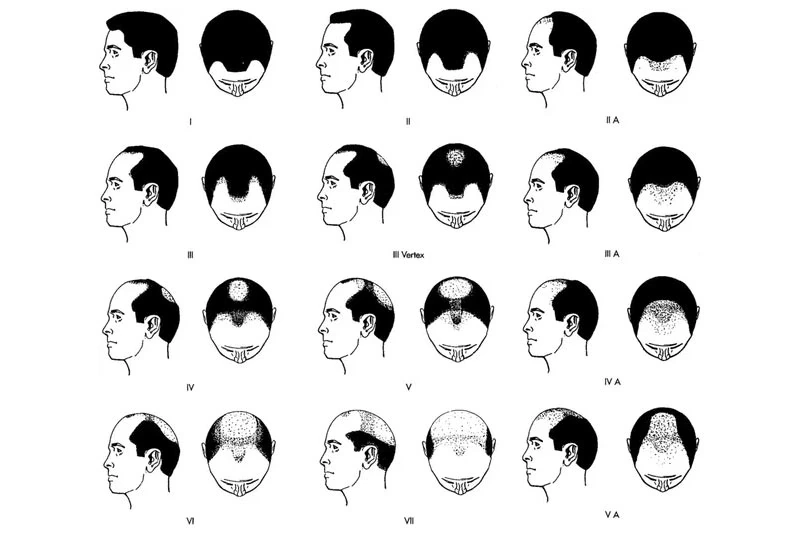
Norwood’s scale – what is it and how to define it? Hair loss does not mean that you suffer from alopecia. You only have to deal with it when the loss of hair prevails over the newly adolescent hair for a long time, which in turn causes thinning of the hair. To assess whether hair loss is actually a result of baldness and its degree, doctors use the Norwood scale, otherwise known as the Norwood-Hamilton scale or Nw for short. It is used primarily to determine the degree of hair loss in male androgenic alopecia.
Some history…
In 1975, the dermatologist and surgeon Dr. O’Tar Norwood used Hamilton’s earlier work to create a qualification of male pattern baldness. For the purposes of creating the scale, 312 white men and 214 white women in the 20-89 age group were tested. Based on the research, the well-known Norwood scale was created, which is used by doctors all over the world.
What is the Norwood scale?
The Norwood Scale is a leading qualification system that is used by physicians around the world to qualify and measure the degree of male pattern baldness. The use of such a scale is possible because men usually lose their hair in one of the many common patterns. The Norwood scale allows you to quickly and easily find these patterns / images and indicates which stage of baldness the patient is at.
What does the Norwood scale help with?
The Norwood Alopecia Grading Scale helps aesthetic medicine physicians to determine the severity of androgenic alopecia as well as to diagnose the condition in general. On its basis, the doctor can also suggest treatment options to the patient, and then effectively measure its effects.
Norwood scale for men only
The Norwood scale is used by aesthetic medicine only in the diagnosis of male androgenetic alopecia. In the case of women, the so-called Ludwig’s scale. This is due to the fact that in women hair loss occurs evenly over the entire surface of the head, which means that thinning is most noticeable around the parting. In the case of men, androgenetic alopecia takes a completely different form. Hence, one tool cannot be used for both sexes.
The 7 stages of hair loss according to the Norwood scale
The Norwood scale indicates 7 stages of baldness. Each of them measures the severity and type of baldness. The characteristics of the individual stages of baldness are:
Stage 1. No significant hair loss or hairline recession. There is the so-called “Teenage” hairline, i.e. no deep curves.
Stage 2. There is a slight recession in the hairline around the temples, that is, front hairline recession and gentle shifting curves. At the second stage, there is the so-called mature hairline.
Stage 3. The first clinical signs of baldness appear. The hairline becomes deeply recessed on either side of the temples, resembling an M, U or V shape. The recessed areas are either completely naked or poorly covered with hair.
Stage 4. There is a noticeably receding hairline as well as darkening in the dark area, ie significant hair loss at the top of the head (apex).
Stage 5. The hair recession is more severe than stage 2, and there is sparse or no hair at the top. The two areas of hair loss are separated by a strand of hair that joins the strands on the sides of the head.
Stage 6. Both areas of hair loss are larger and merge into one, increasing the hair-free area.
Stage 7. The hairline is in the occipital part, the rest is completely absent or very sparse.
#alopecia
#alopecia areata
#degree of hair loss
#hair loss
#hair transplant
#hairloss
#hairtransplant
#norwood scale
#stage of baldness
by MediTravel.com · 25 January 2020 · 3 min read